Genre: Folk/Acoustic
Nonesuch Records
Running Time: 32:49
I don't know about you, but it always seemed like Radiohead was Thom Yorke and those four other guys.
They are a major part of the band's success, no doubt, but Yorke was the face of the band. So it's no surprise that Phil Selway, the drummer in this band, was going to be mostly unknown, because:
a) Yorke steals all the headlines
b) most people don't pay attention to the drummer anyway
But maybe people should pay attention to this drummer. If there ever was a notion that Yorke was the only real talent in the band, Selway blows it away with his debut solo album, Familial.
Familial is quiet, moving, introspective, and moody. The softness of Selway's vocal combines with acoustic guitar to make Familial one of the most sublime albums of 2010.
Selway wrote each of the 10 compositions himself. What Selway is doing here is not unlike Conor Oberst's work with Bright Eyes, though Oberst tends to be more folky. I have a hard time describing Selway as folk; it's more like "Karma Police" combined with the moodiness of "Exit Music (For a Film)."
"By Some Miracle," "Beyond Reason," and "The Ties That Bind" have the strongest sense of melody and as such, are the standout tracks. The drumming is kept to a miniuim and never makes much of an impact.
It's not really needed. Selway proves that he's capable of capturing the listener's attention in his own right.
Selway's lyrics are also superb. One of the major themes on Familial seems to be dealing with conflict and feelings of fear, apprehension, and doubt.
"By Some Miracle" speaks about what it's like to struggle with personal demons, "Patron Saint" deals with being betrayed by a friend and the feelings of bitterness it leaves, while "The Ties That Bind" is a letter to a father wishing for a better life for his son.
"All Eyes On You" deals with a subject many people struggle with - public speaking. You've been invited to a once in a lifetime interview, Selway tells you, and the pressure of the situation makes you so nervous you can't speak.
"And you're embarrassed too
Afraid of the light that shines on you
So frail and so small
So scared, you're terrified by all
The eyes on you"
Granted, not every moment of the album is totally stellar. In some places the album is a little too mellow and wanders a bit, but it's a heck of a start for Selway. As good as he is behind a drumkit, he proves he's even better when taking center stage himself.
Score: 83/100
Sunday, October 17, 2010
Thursday, October 14, 2010
Interview with Yossi Sassi Sa'aron from Orphaned Land
I caught up with Yossi Sassi Sa'aron, guitarist from Orphaned Land, after their show at the Masquerade on Oct. 5. I chatted with him about Iron Maiden, and his favorite concert venue, among other things. My friend Josh Rogers starts the interview, then I take over at about 5 minutes in.
Labels:
Masquerade,
Orphaned Land,
Yossi Sassi Sa'aron
Saturday, October 9, 2010
Katatonia brings taste of Swedish Metal to the Masquerade
There’s something about a metal concert that words just can’t quite capture.
There’s the thump that you feel in your heart every time the drummer hits the kick pedal. The basslines that you could never seem to make out on the CD become so dynamic and fluid as it pulses through the crowd. And then, there is the decibel factor. When you leave a show, your ears will still be ringing when you wake up in the morning.
I got a chance to witness three great bands perform at The Masquerade in Atlanta Monday night, each with their own distinctive style and background. Progressive Rockers Orphaned Land, hailing from Israel, Finnish Doom metallers Swallow the Sun, and Swedish hard rockers Katatonia. It was an unbelievable night of metal that I won’t soon forget.
Hell Hath no Fury Like a Concert Goer Cramped
First, a little about the venue. The Masquerade consists of two concert arenas; the upper level is called Heaven and down below is Hell. Makes sense, right? Heaven, from what I’m told, is a spacious venue where the major bands play. I got to witness these fine bands straight from the jaws of Hell.
Hell is smaller and much more cramped, but you get a chance to get closer to the bands. If you go up the ramp on the right hand side there’s a seating area to the side of the stage, and there’s literally nothing but a rail separating you from where the band plays. You can slap fives with the band, etc., between songs and sets, and it makes for a great atmosphere.
Everybody jump for Orphaned Land!
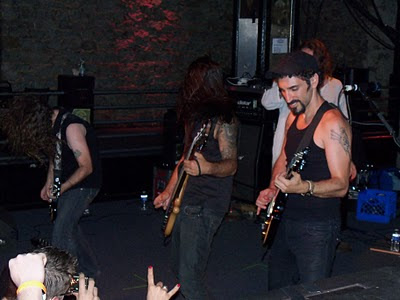
The show kicked off with Orphaned Land, whose influences range from Iron Maiden and Depeche Mode to the more traditional Middle Eastern music of their homeland. On their albums, they’re well known for using a diversity of instruments, but here they went with strictly a guitar/drums/bass setup.
They interacted with the crowd very well. The guys looked like they were having a great time on stage, and that energy transferred into the crowd – It was something they could feed off of. Their vocalist, Kobi Farhl, would instruct the crowd to jump while the band played, trying to get them into it even more.
I also thought it was cool how the drummer really got into it to. He would stand up behind his kit and try to get the audience into it.
| Orphaned Land brings a taste of the Middle East to Atlanta |
Swallow the Sun Swallows the Tempo
Next up was Swallow the Sun, a band I had the privilege to see perform at the Muse in Nashville in 2009, and I also met their vocalist, Mikko Kotamäki there. When they took the stage the lights dimmed which made for a more gloomy atmosphere.
Swallow the Sun slowed down the pace from the frenetic, bouncing around tempo that Orphaned Land established, but it helped set the mood for their style: a much more slow, heavy , doom type metal vibe. They do a fantastic job of creating atmosphere.
Vocalist Kotamäki is capable of pretty melodic vocals, but can also deliver deep growls – picture Mikael Akerfeldt type growls. And he also pulls off bloodcurdling shrieks. They have great melodic guitar leads and expert arrangements on keyboard .
Drummer Kai Hahto was also impressive. He was keeping some complex beats on the drum pads while employing lightning fast double bass.
Chill Out: It’s Time for Katatonia!
The last band of the night was the headliner, Katatonia. What amazed me about them was how they were able to go from having a very mellow, chillout vibe one minute to being heavy as hell the next. I can’t think of many bands who can combine that as well as Katatonia.
Their sound is based on pretty, melodic guitar leads and flowing bass lines, while still bringing the intensity of a metal band. Katatonia was playing without guitarist Fredrik Norrman and bassist Mattias Norrman, who left in 2009.
Katatonia’s appearance got the crowd even more engaged than before; The audience began energetically chanting for “Forsaker.” Somebody threw a bra onstage. And then the moshing broke out.
The last major metal concert I went to gave me the chance to get my first brush in a mosh pit. It was neat; I got a major scrape right under my chest. The moshing didn’t really get started until Katatonia got into the meat of their setlist, but when it did it became frenetic.
After a short encore, Katatonia was done and it was time to head home. I mingled with members of Orphaned Land and Swallow the Sun, who had gathered down by the merchandise table. I also snagged some merchandise, took photos, and got an album signed. The experience put a considerable drain on my bank account, but it was worth it for the great time and memories made.
I said there are things about a metal concert that can’t be put into words, although I guess I tried my best here. The best thing I can say is get out to your local venue and support some bands if you get the chance. You’ll see what all the fuss is about.
![]() |
| Katatonia has officially achieved Rock God status. |
"The Final Frontier" is latest epic from Iron Maiden
Genre: MetalSony Legacy
Running Time: 76:39
Iron Maiden have been on a lot of wacky adventures over the years.
They've flown with the Icarus, discovered secret performances of satanic rituals, and hid out in the Rue Morgue. They've even read Dune by Frank Herbert.
Over the last 30 years, Maiden has been one of metal's most consistent bands. Since the release of their 1980 eponymous debut, the band has never gone more than four years without releasing an album.
So with the recent release of their 15th studio album, The Final Frontier, are they ready to continue their march forward, or have the years finally caught up with them? Maiden has released a decent album, but one that may struggle to stand the test of time.
The Giant Elephant in the Room: The Length
The two albums prior to The Final Frontier showcased two vastly different sides of Maiden. 2003's Dance of Death was very melodic, so much so that it almost sounded like a pop metal record at times.
The followup, 2006's A Matter of Life and Death, took the opposite approach by stringing out long epics. The Final Frontier fits more closely in the vein of the latter record than the former. The songs are long, drawn out, and usually don't really seem to go anywhere.
The #1 issue with The Final Frontier is not the length of the songs. It's more in the lack of melody, the lack of creativity and a general lack of direction in this album. It's a sobering thought, but it appears Steve Harris and Co. may be running low on musical ideas.
The guitar work, whcih was once one of Maiden's strengths, really dosn't impress on this album. Not even the guitar solos really do much for me.
And it's clear at this point that Bruce Dickinson's voice is no longer what it once was. The wear started to become noticeable on A Matter of Life and Death, but on the latest album it's hard to deny that something is up with Bruce's voice.
The fact that the songs are so long just further hamstrings the album's appeal. Out of the last five songs on the album, only "Starblind" is under eight minutes. Three of those songs clock in over a whopping nine minutes, with the closer "Where the Wild Wind Blows" nearly cracking the 11 minute mark.
You don't have to try to write Beowulf on every song, guys.
Maiden's Sense of Melody
There are three good songs on this album - "El Dorado," "Where the Wild Wind Blows," and the title track. Then there's one decent track - "The Alchemist." The rest of the songs aren't bad, they just aren't particularly memorable.
When the formula works, it's because the band has its sense of melody working. For examples, see the chorus of "El Dorado" or the guitar lead in the beginning of "When the Wild Wind Blows." There definitely are flashes of brilliance.
Lyrical Brilliance
Oh, and speaking of positives, did I mention the lyrics? No matter what anybody says about this album, you can't knock the lyrics. "The Man Who Would Be King" tells the story of man on the run, wanted for murder. When you read the lyric sheet you can pitcure him making his way across desolate barrens, searching for salvation.
"The Alchemist" tells the tale of a once powerful mage who met an untimely end. And the closer, "When the Wild Wind Blows," is an emotional story about a family and society preparing to face nuclear warfare. If there's a standout track on the album it's this. No other song on the album pairs Maiden's storytelling talents with a compelling musical soundscape like this track does.
I thought the way the story ends was pretty lame, however. I won't spoil it, but it's just so lame and such a copout that it actually degrades the quality of the track as a whole. M. Night Shyamalan would be shaking his head in disgust if he were to read this one.
Maiden Reaches into their Bag of Tricks
On the opener, "Satellite 15... The Final Frontier," the band pulls off a little trickery. The album opens with a sporadic, twisting bassline and then ominous guitar strains break in over top of that. You'll wonder if you popped in the wrong CD.
Surely you think once Bruce's vocals kick in it will restore a sense of normalcy - but no! Dickinson's whispy and fleeting vocals tell the tale of a man trapped on a satellite being sucked toward the sun. It sounds like some kind of bizarre, alternate reality version of Maiden.
Just before the five minute mark the band changes gears and returns to the Maiden sound we all know and love. But the first part of the song does such an effective job of creating a sense of foreboding that it could literally put a lump in your stomach. Sadly, it's one of the few times on the entire album the band does somethhing interesting musically.
Where Maiden Stands with this Album
Iron Maiden possesses a great musical legacy, having come out of the New Wave of British Heavy Metal Movement in the early 1980s. They're without question the only band from that era to still remain even remotely relevant today (the only other possible contender being maybe Saxon.)
But since their critically acclaimed comback album Brave New World in 2000, it's been a mixed bag. They need something fresh, a new sense of direction. When Maiden hangs it up for good, it will be a sad day for metal, but hopefully they can pull out something better before then. If not, their final years may end up being remembered as Wasted Years.
Tracks to check out:
Satellite 15... The Final Frontier
El Dorado
When the Wild Wind Blows
Lyric to use as your Facebook status:
"I was the keeper of the books
I had the knowledge of the scrolls
But now through ignorance and fear
I cast a shadow through the years"
- The Alchemist
Score: 77/100
Labels:
Bruce Dickinson,
El Dorado,
Final Frontier,
Iron Maiden,
Maiden,
Steve Harris
Tuesday, September 28, 2010
Cash delivers parting message with "Ain't No Grave"
Genre: Country
American Recordings/Lost Highway
Running Time: 32:23
In 1994, Johnny Cash was looking to resurrect his career. After dominating the American music landscape for the three previous decades, Cash was faced with a major lack of support throughout most of the 80s. Then came Rick Rubin, and the beginning of the American Recording series.
This year saw the release of the sixth and (supposedly) final installment in the series, American VI: Ain't No Grave. Cash's American Recordings have become famous for its stripped down approach - most songs feature just Johnny and his acoustic guitar. After the release of American IV: The Man Comes Around in 2002, Cash began recording material for one final album.
Following his death in 2003, that material was released on American V: A Hundred Highways and now on his latest album, American VI: Ain't No Grave. Fans of Cash will not be disappointed; here is an opportunity to hear the man in fine form for one final time.
If you're familiar with Cash's past few American Recording albums, you'll know what to expect. Music or style wise, he hasn't changed it up very much. Most of the album is cover songs, but he makes them his own with his mournful voice and acoustic guitar. It's a true spectacle.
Cash is known for covering songs from many different genres; some of these include The Beatles "In My Life" Depeche Mode's "Personal Jesus" and most famously, Nine Inch Nails "Hurt." Here, Cash sticks mostly to Country, Western, and Folk material.
It seems almost every song contains some type of life lesson. Ed McCurdy's "Last Night I Had the Strangest Dream" is a hymn to ending war; Porter Wagoner's "Satisfied Mind" warns that money isn't everything; Kris Kristofferson's "For the Good Times" teaches us to appreciate life's finer moments.
There are also major spiritual elements present on the past few Cash albums, and those pop up again here. The title track sees Cash fully prepared to meet his savior. The haunting melody, coupled with Scott Avett's banjo performance make this song the centerpiece of the album. Sheryl Crow's "Redemption Day" is a thoughtful track that looks forward to the next world.
There is one Cash original, "I Corinthians 15:55." The lyrics portray Johnny as a ship captain, sailing into eternity. The Bible passage to which the title refers is quoted in the chorus. I found it a nice touch.
American VI: Ain't No Grave will stand as one of Cash's most introspective albums. It's very somber in tone, and as a result, perhaps lacks some of the variety that his previous albums had.
There's no hint of Cash's grit or humor that was seen on tracks like "Delia's Gone" or "Tennessee Stud" from the first American Recordings album. There aren't any real upbeat tracks, like "Sam Hall" or anything with the groove of "Like the 309," both from American V: A Hundred Highways.
Though perhaps this is what gives American VI: Ain't No Grave its identity.
It's a touching, poetic, and revelatory piece of work. Cash knew his time was short when he made these recordings. This was his final message to the world.
Check out these tracks:
Ain't no Grave
For the Good Times
I Corinthians 15:55
Lyric to use as your Facebook status:
Oh let me sail on
With my ship to the East
And keep my eye on the North Star
When the journey is no good for man or for beast
I'll be safe wherever you are
Score: 83/100
Thursday, September 23, 2010
Big Boi makes big waves with solo debut
Genre: Rap
Def Jam Recordings
Running Time: 57:43
On Sir Luscious Left Foot… Son of Chico Dusty, Big Boi says he’s got a back up plan for his back up plan. Why? To back up his back up plan! But first let’s back up and explain a few things about this album.
Big Boi rose to fame as a member of the rap group Outkast, serving as one half of the outfit that turned out some of the biggest hip-hop albums of the last decade, Stankonia and Speakerboxxx/The Love Below. Now the son of Chico Dusty puts his best foot forward to establish his own identity, but will Sir Luscious prove to have two left feet? One thing’s for sure: Big Boi has produced a big time, radio ready record filled with catchy hooks and some of the smoothest flows we’ve heard in the mainstream rap genre.
But therein lies the problem. Sir Luscious Left Foot isn't quite what I would call a mainstream rap album, but it has many elements of mainstream rap that I feel drags it down. I feel like a lot of the tracks sound like they were meant to be played at a club or a party, and that type of sound doesn't appeal to me so much.
Most songs on Sir Luscious Left Foot follow a formula of having a ear-grabbing sing along R&B hook with smooth laid back rapping in the verses. The album as a whole has a very slick commercial feel to it. Nothing makes this more evident than the opening number, Daddy Fat Sax. Big Boi comes out in grand style, dropping a few verses that sound ready for BET.
If there’s ever a video made foe this song, I can see it taking place during a pool party at a fancy mansion, while scintillating honeys are getting crunk on Corona.
On “Follow Us” Big Boi lays down some great verses, then you have a chorus that sounds like something pulled straight from an Usher track. One of the best examples of this style can be found on “Turns Me On,’ sounds somewhat more Outkast inspired. Sleepy Brown lays down a mellow, relaxing chorus while Big Boi and Joi lay down some chill raps in the verses. It reminds of “I Like the Way You Move.”
Another highlight is “Be Still” with Janelle Monae, who dropped her own critically acclaimed debut album, The ArchAndroid, back in May. Monae’s smooth R&B vocals coupled with the verses Big Boi lays down brings to mind some of 2Pac's collabos with female artists, like "Run Tha Streetz" from his All Eyez on Me album. Albeit much less thuggish.
But the real stunner here is the beat in the chorus. It has got some groove! It actually reminds me of something Aphex Twin would do. Think "4" or "Fingerbib" off The Richard D. James Album.
Tangerine, featuring Atlanta bred rapper T.I., also stands out, although the lyrics are a little less than desirable. Jamie Foxx croons some sweet R&B vocals on Hustle Blood, and Gucci Mane delivers a memorable guest performance on “Shine Blockas.”
He hits a clunker with "You Ain't No DJ." Annoying beat, annoying cliched lyrics - you get the picture. I hit the skip button on this one.
Big Boi himself proves that he’s still a great emcee, consistently doing a great job with his rhyme, flow, and delivery. I feel as though his lyrics aren’t as relevant as they were in his days with Outkast, however.
On Speakerboxxx, he was rapping about things that mattered – politics, religion, being a single father, etc. Here, most of that is gone. On “For Your Sorrows,” he addresses the issue of how many young people don’t read or keep up with the news. “Call it a fiction addiction cause the truth is a heavy thing,” he declares.
Outside of that there’s not too much substance. Most of the lyrics are about money, clubbing, jewelry, and being from Atlanta. I like this album, and I think Big Boi is one of the better well known rappers today. But I think it’s clear he was going for a commercial hip-hop type of sound.
Outkast was always about trying to be different and stand apart from the mainstream trends. I think it would have been better if Big Boi would continue to carry that torch. It’s missing the Outkast zaniness and originality that was present even on Speakerboxxx.
If you have any interest in hip hop you should definitely check this out. If you’re hoping for this record to sound similar to Outkast, you may find yourself in need of your own back up plan.
Tracks to check out:
Turns Me On
Be Still
Shine Blockas
Score: 78/100
Labels:
Big Boi,
Gucci Mane,
Janelle Monae,
Outkast,
Sir Luscious Left Foot
Saturday, September 11, 2010
Eminem recovers nicely on Relapse followup
Genre: Rap
Aftermath Records
Running Time: 77:06
In the late 90s and early 2000s, Eminem released some of rap's greatest albums. The Slim Shady LP and the Eminem Show were startling displays of Em's lyric writing, and his mastery of rhyme and flow. But it was his 2000 album, Marshall Mathers LP, and all the controversy surrounding it that lifted Mathers to superstardom.
Which is why it was no surprise that when the rapper made his comeback with 2009's Relapse album that there was a lot of buzz. In the opinions of many, he fell far short of the mark. Which is part of what makes Recovery so interesting. Just when it looked like Mathers was done, he returns with a remarkable return to form that is sure to shush the critics.
One of the great things about Recovery is that Mathers has regained his old form in terms of rhythm, flow, and delivery. The tacky accents that marred Relapse are gone. Even better, he's ditched a lot of old topics he discussed on previous albums.
No more Kim, no more drama with his mom, no Ken Kaniff, and no more cussouts from Steve Berman. It's great to see him try to move on because those were subjects that were honestly run into the ground.
So, you may wonder, if Mr. Mathers isn't discussing his family issues, etc., then what exactly does he rap about? Well, that's kind of the kicker. He doesn't have all that much to say. Some of his most interesting material sees him discussing the turmoil he was going through while he was trying to ditch drugs. On "Talking To Myself," Em reveals that he considered recording diss tracks against Lil Wayne and Kanye West.
He also admits that his last two albums, Recovery and 2004's Encore, weren't that great.
Outside that, a lot of his subject matter revolves around - what else? Women. Either he's banging your girlfriend or he's being ditched by one. In some respects it's interesting, because he talks about relationships on this album in a way that he hasn't done since his debut, Infinite.
But there are a long run of tracks where he gets a little too into the melodrama of bad relationships. Save it, Em. I have a feeling I'll get plenty of that when I review the Taylor Swift CD.
Eminem's lyric writing skills just aren't what they used to be. Some of them are just downright corny. On "Not Afraid," he says he's going to go into a club and lift up the liquor stand because he's "raising the bar." Get it? It's a steep decline for the man who used to stand out like an orange hat with a green bill. Also, he talks about dicks a lot.
There are a couple of other things he does on this album I find interesting. First, his voice sounds a little different on this album. It's like they pumped his vocals up a little too much in the mix. Not a huge deal, but it would have been better if they'd toned it down a little in production.
I haven't heard Em use samples of other songs very often, but he does it on a couple of tracks here to varying degrees of success. On "Going Through Changes," he samples Black Sabbath's "Changes." I don't think it works to well; Ozzy's voice sounds totally out of place on a rap song. However, on "No Love," he uses a sample of Haddaway's "Don't Hurt Me" to summon his inner mojo. It's very effective at giving the track a club feel without being tacky.
Other highlights include "Cold Wind Blows," which may be the album's best song, with its sing-along chorus. "Won't Back Down" has a clunky but infectious beat with loud drums. On "Almost Famous," he waves a Pittsburgh Steelers Terrible Towel while name dropping Austin Powers and Verne Troyer, and other pop culture references.
"No Love" features Lil Wayne's southern drawl on full display. But the real stunner is Rihanna's performance on "Love the Way You Lie." The R&B/pop starlet brings the house down, while Em tales a tale of domestic violence. Overall, it's Em's most real and visceral album since The Eminem Show. It has some flaws, but it certainly is a solid addition to his catalog.
Score: 82/100
Labels:
Eminem,
Lil Wayne,
Love the Way You Lie,
Recovery,
Rihanna
Subscribe to:
Posts (Atom)